
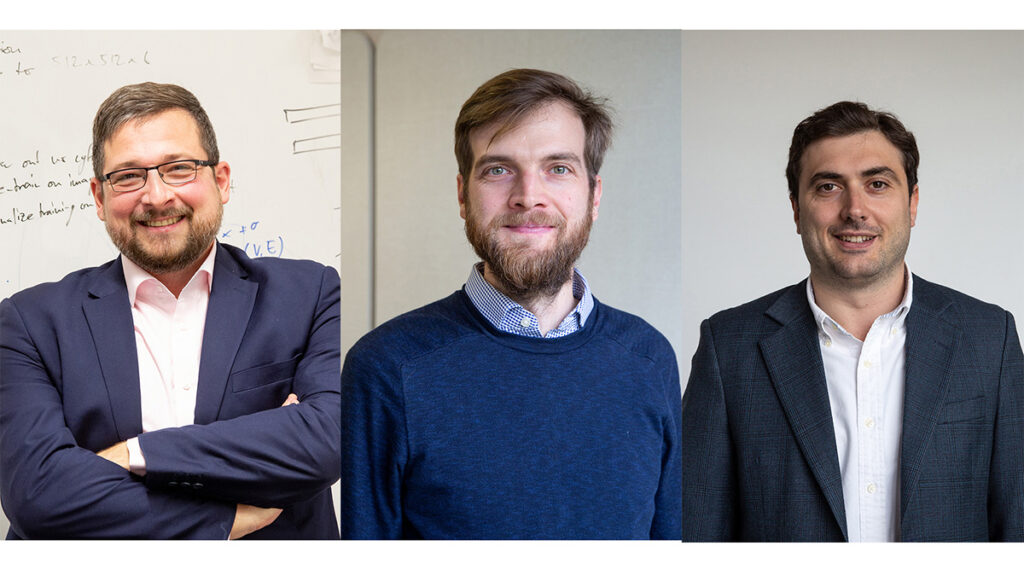
A major success for Friedrich-Alexander-Universität Erlangen-Nürnberg (FAU) and, in particular, for the Faculty of Engineering: Not just one but three researchers have been awarded a Proof of Concept Grant from the European Research Council (ERC). €150,000 each for AI researcher Bernhard Kainz, biomechanic Alessandro Del Vecchio, both from the Faculty of Engineering, and pharmacist Gregor Fuhrmann (Faculty of Sciences).
Prof. Dr. Bernhard Kainz aims to train collaborative AI models to track patterns in patient data that are associated with certain illnesses. Prof. Dr. Alessandro Del Vecchio is developing biocompatible electrodes that give patients with spinal injuries some of their mobility back. Prof. Dr. Gregor Fuhrmann is working to pack antibiotics in innovative nanoparticles and transport them to exactly where they are needed in the body. The funding of €150,000 euros should enable the researchers to explore the potential benefits of their research for society or industry.
Training AI agents to collaborate with each other: Prof. Dr. Bernhard Kainz
Patient data are a treasure trove of knowledge. Using artificial intelligence it will be possible to sift through huge data sets and discover hitherto hidden patterns and biomarkers that are connected to certain illnesses. “Often, such connections are not even suspected,” says Bernhard Kainz. “For example, anomalies in the retina can be an indication of heart problems.”
Kainz, Professor of Image Data Exploration and Analysis at FAU, is not looking to develop one single AI model for his research. Instead, he aims to train several AI agents to interact with each other and discover new connections between phenotypes and diseases. Unlike classical language models, AI agents largely work autonomously. “One problem is AI’s basic property of aiming to achieve as much consensus in communication as possible, which doesn’t always lead to the best results,” explains Kainz. “We are therefore developing collaborative environments that allow for scientific discourse in which results are questioned independently.”
Bernhard Kainz will use the new funding to target pancreatic cancer, a disease that is particularly difficult to catch in the early stages and has a poor prognosis. The AI should structure large volumes of clinical data, molecular biological findings and laboratory values, group phenotypes and connect imaging data with molecular patterns. It is expected that the agents will provide publishable and clinically relevant findings. This would not only benefit cancer research, but also introduce a shift in biomedical research towards an automated, data-supported process.
Enabling paralyzed patients to grasp again: Prof. Dr. Alessandro Del Vecchio
Spinal cord injuries have a dramatic impact on patients’ mobility. In most cases, however, a few nerve cells remain in the muscles that are capable of translating motor commands into movement. It is these motor neurons that are the starting point for the research conducted by Alessandro Del Vecchio, Professor of Neuromuscular Physiology and Neural Networks at FAU. He develops hand prosthetics that detect a patients’ intention to make a movement and allow patients to make grasping movements in real time. “To do so, we detect the electrical activity of muscles and use AI to help prepare them for the assistance systems,” Del Vecchio explains.
One sticking point in the system are the electrodes: On the one hand, they should deliver accurate results, but on the other they should not place too great a strain on the patients. Alessandro Del Vecchio’s team is therefore working on innovative biocompatible implants that can remain in the muscles for a prolonged period of time. “Until now, we have been using stainless steel needles with a plastic sheath,” Del Vecchio explains. “As the new electrodes do not require this sheath, they are only half the size, approximately the width of a human hair. At the same time, they deliver better data, meaning that we can implant fewer of them.”
To develop the new material, Del Vecchio is working closely with Prof. Dr. Stefan Rosiwal from the Chair of Materials Science and Engineering for Metals at FAU, who has unique expertise in the area of ultra-hard coatings. The long-term goal of the project is to develop electrodes that are capable of remaining in the body for months or even years.
Creating nanocapsules from bacteria and loading them with antibiotics: Prof. Dr. Gregor Fuhrmann
Rounding out this triple success for FAU is Prof. Dr. Gregor Fuhrmann from the Faculty of Sciences. The pharmacist will also receive a grant of 150,000 euros. He is working to pack antibiotics in innovative nanoparticles and transport them to exactly where they are needed in the body.
You can find the full article on the FAU news portal: www.fau.eu/2026/07/news/three-erc-proof-of-concept-grants-for-fau/
ERC Proof of Concept Grant: The European Research Council’s (ERC) Proof of Concept (PoC) funding line is aimed at researchers who already hold an ERC grant and now want to advance a finding from their ongoing or completed project beyond the scope of academic research A PoC allows researchers to explore the commercial or societal potential of the results of their project. This is the first step towards transferring findings to the market and society. The funding of €150,000 is awarded for a period of 18 months.