
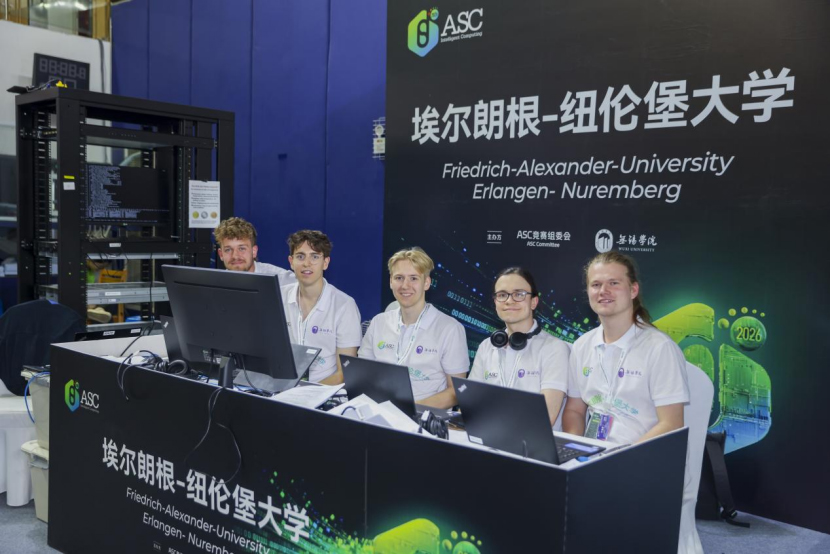
Outstanding performance by team “FAUltier” during the Asian Supercomputer Challenge
A team of students from the Faculty of Engineering at Friedrich-Alexander-Universität Erlangen-Nürnberg was extremely successful in this year’s Asian Supercomputer Challenge (ASC). The FAUltier team rose to the challenge during the final of the largest student supercomputer competition in the world, being chosen as the best international team and awarded First Prize.
The ASC is considered to be the largest of the three international student cluster competitions. Whilst the competitions held within the context of the Supercomputing Conference in the USA and the International Supercomputing Conference in Germany are particularly prestigious, the ASC regularly attracts the most participants. This year, 25 teams qualified for the final in Wuxi, China, after more than one hundred teams participated in the virtual preliminary round.
From flow models to weather simulation
A similar challenge is at the heart of all student cluster competitions:The students must design and set up a high-performance platform of their own and use it to solve a number of challenging scientific and technological tasks within a tight timeframe. This covers classic performance tests as well as applications from flow mechanics, molecular simulations, genome research, weather modeling or artificial intelligence.
Supercomputers under competition conditions
The obligatory power limit is particularly challenging. While modern supercomputers can consume megawatts of power, the systems in the competitions are limited to just five to ten kilowatts, depending on the event. The limit for this year’s ASC was set to just five kilowatts, and yet the computer systems were still 100 times faster than currently available high-end laptops. With this restriction, the teams had to perform complex scientific applications covering areas such as AI, quantum simulation and climate modeling as efficiently as possible and make optimum use of their computing power.
However, rapid computation alone is not sufficient. The students have to construct, install, administer and optimize their systems themselves. They therefore require a knowledge of system administration, computing architecture, parallel programming and scientific computing. At the same time, the competition demands advanced teamworking skills, time management and the ability to react to unexpected challenges under high pressure as well as a talent for communication when presenting the results to a jury of experts.
Many years experience in providing support for early career researchers at FAU
For the FAU team Lorenz Löwe, Anton Wiede, Malte Fischer, Frederik Janssen and Adrian Lachmann with their supervisor Melanie Heckel, the intense preparations paid off. The five students had already participated in the Student Cluster Competition at the Supercomputing Conference in the USA last year, and gained a place in the top 10. They were able to draw on the valuable experience they gained in St. Louis during the competition in Wuxi.
FAU has a long tradition of supporting early career researchers in the area of high-performance computing. For years now, the FAU teams have been supported by the Department of Computer Science and the Erlangen National High-Performance Computing Center (NHR@FAU).
Since 2016, the Professorship for High-Performance Computing run by Prof. Dr. Gerhard Wellein and the Chair of Computer Architecture led by Prof. Dr. Dietmar Fey have been offering a joint practical course in which students learn the fundamentals of modern high-performance computers and gain practical experience.
“Such competitions teach much more than technical expertise,” emphasizes Jan Laukemann from the team of supervisors at the National High-Performance Computing Center NHR@FAU. “Students learn to solve complex problems under realistic conditions, to take on responsibility and to work as a team.”
Contact:
Jan Laukemann
Erlangen National High-Performance Computing Center (NHR@FAU)
jan.laukemann@fau.de